Paper wasps and southern yellowjackets build colonies rapidly under the soffits of two-story homes in The Heights, Montrose, and Garden Oaks due to persistent Gulf Coast humidity and long warm seasons. Elevated…
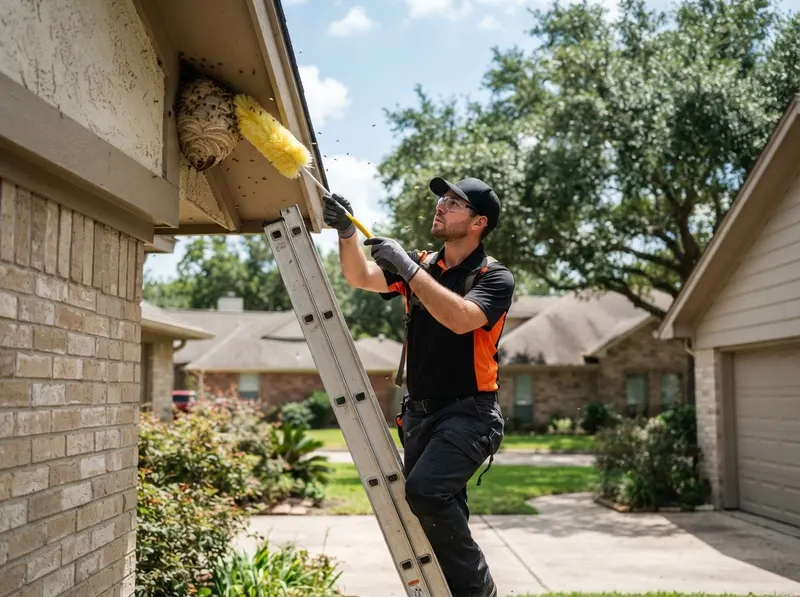
Paper wasps and southern yellowjackets build colonies rapidly under the soffits of two-story homes in The Heights, Montrose, and Garden Oaks due to persistent Gulf Coast humidity and long warm seasons. Elevated humidity along Buffalo Bayou and Memorial Park provides continuous prey for predatory wasps, driving nests inside weep holes, crawlspaces, and attic louvers. Store-bought retail sprays routinely fail against mature colonies because aerosol reach rarely penetrates the interior paper comb, which causes agitated insects to disperse through open soffits and air conditioning return vents directly into interior living spaces.
Nest elimination differs from basic perimeter spraying by addressing the physical hive mass and the pheromone-soaked substrate. A technician applies a targeted residual knockdown agent to neutralize the defending workers, followed by mechanical scraping of the attachment point and treatment with an enzyme-based residue cleanser. If an active yellowjacket colony enters a brick weep hole in a River Oaks or West University Place residence, treating only the outer brick wall traps hundreds of surviving insects behind the drywall. The trade-off between exterior aerosol knockdown and full wall-void extraction is access invasiveness; concealed colonies require controlled interior wall-plate access or mechanical vacuum extraction to remove thousands of rotting larvae that otherwise generate foul odors and attract secondary dermestid beetle infestations.
Properties in Kingwood, Spring Branch, and Meyerland frequently encounter subterranean yellowjacket nests within root systems and hollow decorative landscaping ties. Flooding along bayous forces these ground-nesting colonies higher up into brick weep screeds and residential garage framework. Standard operating procedure requires identifying whether the specimens are native pollinators or aggressive social hornets before chemical application, ensuring compliance with Texas Department of Agriculture structural pest control rules while protecting pets and residents from airborne pesticide drift near exterior HVAC condensers.
Every job gets a firm, written price after a free on-site visit.
Tell us about your stinging insect and nest removal job in Houston and we'll send a clear, written quote, usually the same day.
 Silver Wagon Pest Control