Structural pest remediation in Gulf Coast climates demands precise lethal protocols because Houston humidity accelerates insect metabolism and pesticide breakdown. Whole-room thermal remediation utilizes industrial…
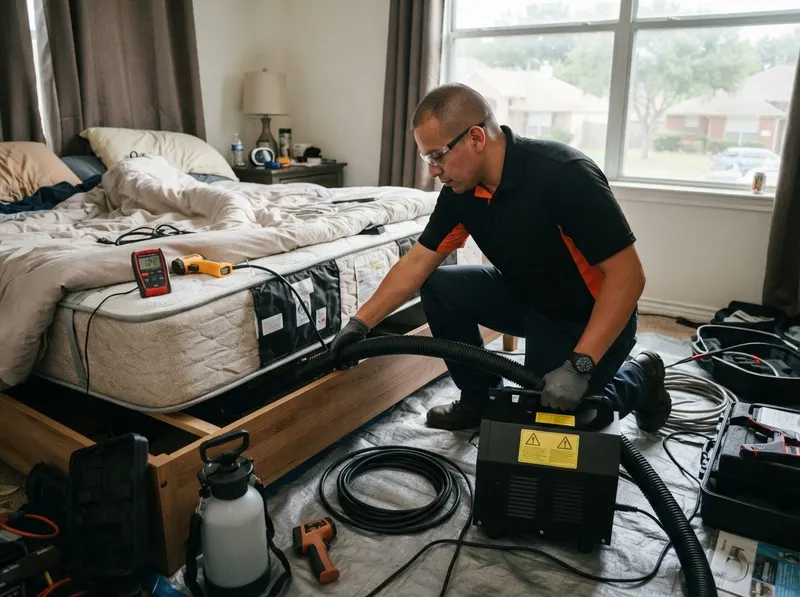
Structural pest remediation in Gulf Coast climates demands precise lethal protocols because Houston humidity accelerates insect metabolism and pesticide breakdown. Whole-room thermal remediation utilizes industrial forced-air heaters and ductwork to elevate ambient indoor air to 120°F, 140°F, maintaining that temperature for a minimum of 90 minutes. This sustained heat penetrates deep into mattress seams, hardwood flooring expansion gaps, and drywall cavities where bed bugs harbor. At 122°F, all life stages, including desiccation-resistant eggs, reach thermal death points within minutes. In dense neighborhoods like Montrose and The Heights where historic pier-and-beam foundations allow indoor microclimates to shift rapidly, standalone thermal remediation treats the entire space simultaneously without requiring chemical exposure near internal HVAC systems.
Chemical eradication serves as a strategic alternative or targeted perimeter defense. Non-repellent insecticides, insect growth regulators (IGRs), and desiccating dust formulations are applied directly into electrical faceplates, baseboard cracks, and door jambs. While thermal treatment offers complete knockdown in a single 6-to-8-hour visit, it leaves no protective barrier once equipment cools. Conversely, precision chemical applications in West University Place or River Oaks provide up to 90 days of continuous residual suppression, intercepting newly introduced bugs. The trade-off is mechanical: thermal treatment requires extensive preparation, including removing wax candles, electronics, and aerosol containers, whereas chemical protocols demand multiple application cycles spaced 14 days apart to target freshly hatched nymphs that survived initial contact.
Multi-family buildings, garden-style rentals, and ranch layouts across Spring Branch, Garden Oaks, and Meyerland present unique architectural perimeter challenges. Bed bug heat and chemical eradication in Houston adapts to construction limits: concrete slabs retain surface heat effectively, while multi-story brick homes near Memorial Park require balanced fan placements to prevent thermal pooling near ceiling drywall. Standard protocol combines these methods into hybrid mitigation for severe harborages. Dispatched technicians first apply desiccating dusts inside structural voids, followed by controlled thermal holding, guaranteeing that fleeing insects contact lethal concentrations as they move toward cooler exterior perimeters.
Every job gets a firm, written price after a free on-site visit.
Tell us about your bed bug heat and chemical eradication job in Houston and we'll send a clear, written quote, usually the same day.
 Silver Wagon Pest Control