Surface granular treatments purchased from big-box retailers consistently fail across Houston's dense gumbo soils because red imported fire ants construct vertical colonies descending up to four feet deep. In…
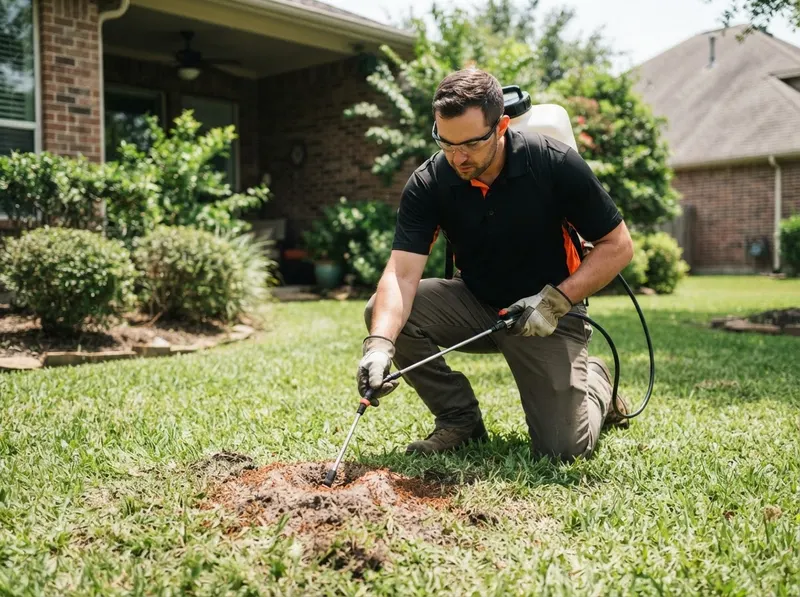
Surface granular treatments purchased from big-box retailers consistently fail across Houston's dense gumbo soils because red imported fire ants construct vertical colonies descending up to four feet deep. In neighborhoods like West University Place, Meyerland, and The Heights, heavy Gulf Coast rains push worker ants to elevate mounds rapidly, yet the reproductive queen remains protected deep within moisture-retaining clay strata. Pressurized mound injection forces fipronil or bifenthrin solutions directly down the gallery channels at 40 to 60 pounds per square inch, eliminating the primary reproductive core in under 24 hours. Broadcast-only retail dusts frequently split these super-colonies, triggering budding where satellite queens scatter into flowerbeds, patio slabs, and HVAC drip lines.
Broad-acre broadcast treatment is paired with mound injection to neutralize unseen foraging workers spanning the entire lawn footprint. Properties along waterways and heavily irrigated turf, such as estates in River Oaks, Memorial, and Kingwood, require specialized dual-method delivery. Injecting a solitary mound halts that specific hazard, but fails to prevent adjacent foraging networks from establishing new dirt caps within 14 days. Granular baits containing insect growth regulators like methoprene or pyriproxyfen mimic natural food stores; foraging workers harvest the bait, transport it past security channels, and feed it to developing larvae, rendering the colony sterile across an entire half-acre or acreage parcel.
Subterranean bait and injection protocols require dry conditions for maximum soil uptake. In areas prone to surface ponding, such as Clear Lake, Garden Oaks, and Spring Branch, applications must align with clear weather windows to ensure rain does not displace granular bait matrices before field foragers ingest them. Treated turf areas remain restricted until liquid mound injection zones dry completely, typically taking two hours under Houston humidity. Service calls require zero forced long-term corporate service retainers, providing stand-alone, heavy-grade intervention that neutralizes active stings and prevents perimeter reinvasion.
Every job gets a firm, written price after a free on-site visit.
Tell us about your fire ant mound injection and turf treatment job in Houston and we'll send a clear, written quote, usually the same day.
 Silver Wagon Pest Control